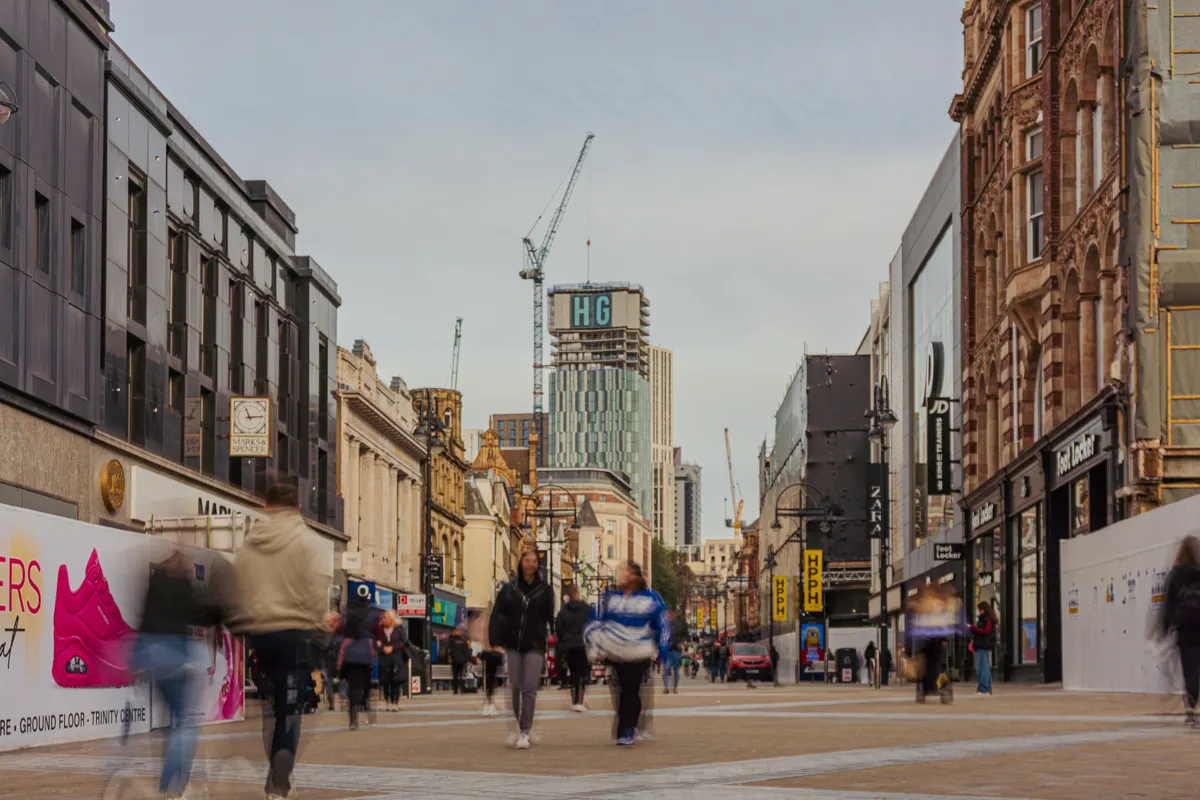

The UK retail footfall decline accelerated sharply in September, with total footfall falling 2.9 per cent year-on-year, almost double the 1.7 per cent drop recorded in August, as consumers grew more cautious ahead of the Autumn Budget. The British Retail Consortium (BRC), which published the data, used the figures to renew pressure on the Chancellor to reduce the tax burden on high street businesses.
The steepest deterioration was in shopping centres, where footfall dropped 3.5 per cent after falling only 0.5 per cent in August. Retail parks also suffered a worsening slowdown, from one per cent in August to 1.7 per cent in September. High streets fared marginally better, with the decline easing slightly from 3.1 per cent to three per cent, though the overall picture remained firmly negative.
England and Wales drag down the UK retail footfall decline
A regional breakdown published by Morningstar reveals the extent to which the UK retail footfall decline was concentrated in England and Wales. Footfall fell by 3.4 per cent in England and by three per cent in Wales. Scotland held up better, recording a 0.7 per cent fall, while Northern Ireland was the only part of the UK to limit the damage, declining by 2.1 per cent.
Helen Dickinson, chief executive of the British Retail Consortium, said retailers in Northern Ireland would be encouraged to see footfall holding up, but added that as the only part of the UK to buck the trend, ‘the wider picture remains gloomy’. Her comments underline how broadly the September weakness spread across the country, rather than being confined to any particular region or format.
The BRC said retailers had expected some seasonal slowing as the warm summer weather faded. What they had not anticipated was a drop-off this pronounced. Andy Sumpter, head of analytics at Sensormatic, which produced the BRC’s data, said retailers ‘cannot attribute this month’s performance to the weather’. ‘Instead, consumers appear increasingly focused on broader economic concerns, including the continued impact of inflation, household spending pressures, fuel costs and uncertainty ahead of the Autumn Budget,’ he said.
Calls for business rates relief grow louder
The figures have intensified calls from the retail sector for government action. Dickinson said retailers will ‘do all they can to attract shoppers with great value and choice’ but warned that without policy change, ‘retailers are fighting with one hand tied behind their backs’. She made a direct appeal to the Chancellor: ‘By pulling back from another increase in business rates, the Chancellor can use his first Budget to unlock vital investment in our shops and high streets, help retailers keep prices down and provide jobs across the country.’
The calls came on the same day that Ken Murphy, chief executive of the UK’s biggest grocer Tesco, urged the government to exempt retailers from the highest business rates multiplier. Murphy echoed similar pressure applied by the chief of John Lewis. ‘We have long argued that the rate system is fundamentally unfair, that retailers pay, on average, four times their fair share of rates,’ Murphy said.
The economic backdrop adds to the pressure on those retailers hoping for relief. Inflation ticked up to 3.1 per cent in August, and economists have warned that the knock-on effects of the Iran war have eaten away at the government’s fiscal headroom, limiting what the Chancellor can offer at the Budget without cutting spending elsewhere.
Retailers had already endured a difficult summer. The year’s multiple heatwaves pushed online sales higher while suppressing in-person visits, leaving many operators with mixed trading results even before September’s marked deterioration in traffic. The question now is whether the Budget delivers enough of a cost-of-business signal to alter the investment calculus for a sector that has spent much of the year absorbing pressures largely outside its control.
