
Donald Trump has threatened to declare the Trump Strait of Hormuz territory of the United States, warning he would make the announcement ‘pretty soon’ as oil prices hold at around $88 per barrel and the waterway remains effectively closed to crude shipments. The threat marks a sharp escalation in rhetoric between Washington and Tehran, now approaching six months since the two countries first broke out into conflict on 28 February.
‘After we finish defeating Iran, which is being very badly defeated, pretty soon I’ll be declaring the Hormuz strait a territory of the United States,’ Trump said. ‘Essentially, that’s what it is. We have the blockade. No ships get through unless we want them to.’
Iran fires back over Trump’s Strait of Hormuz territory claim
Tehran did not let the statement pass unchallenged. Major general Amir Hatami dismissed the remarks, saying that ‘joking about such remarks’ was a ‘major mistake’, and warned that Iran had ‘defenders who will break your legs.’
Kazem Gharibabadi, Tehran’s deputy foreign minister, posted on X: ‘This strait will be opened and closed only under Iran’s command, and so long as you do not accept the reality of defeat and stop indulging in fantasies, Iran will continue to enforce the blockade.’
The exchange underlines how far negotiations over the strait’s future have stalled. With neither side showing any sign of yielding, markets are left to price in a prolonged closure of one of the world’s most consequential shipping lanes.
A choke point the world can ill afford to lose
The scale of the disruption is difficult to overstate. According to the International Energy Agency (IEA), an average of 20 million barrels per day of crude oil and oil products were shipped through the Strait of Hormuz in 2025, accounting for around 25% of the world’s entire seaborne oil trade. Even before the conflict, roughly 20% of global supply passed through the passage, with more than 130 ships transiting it on a typical day.
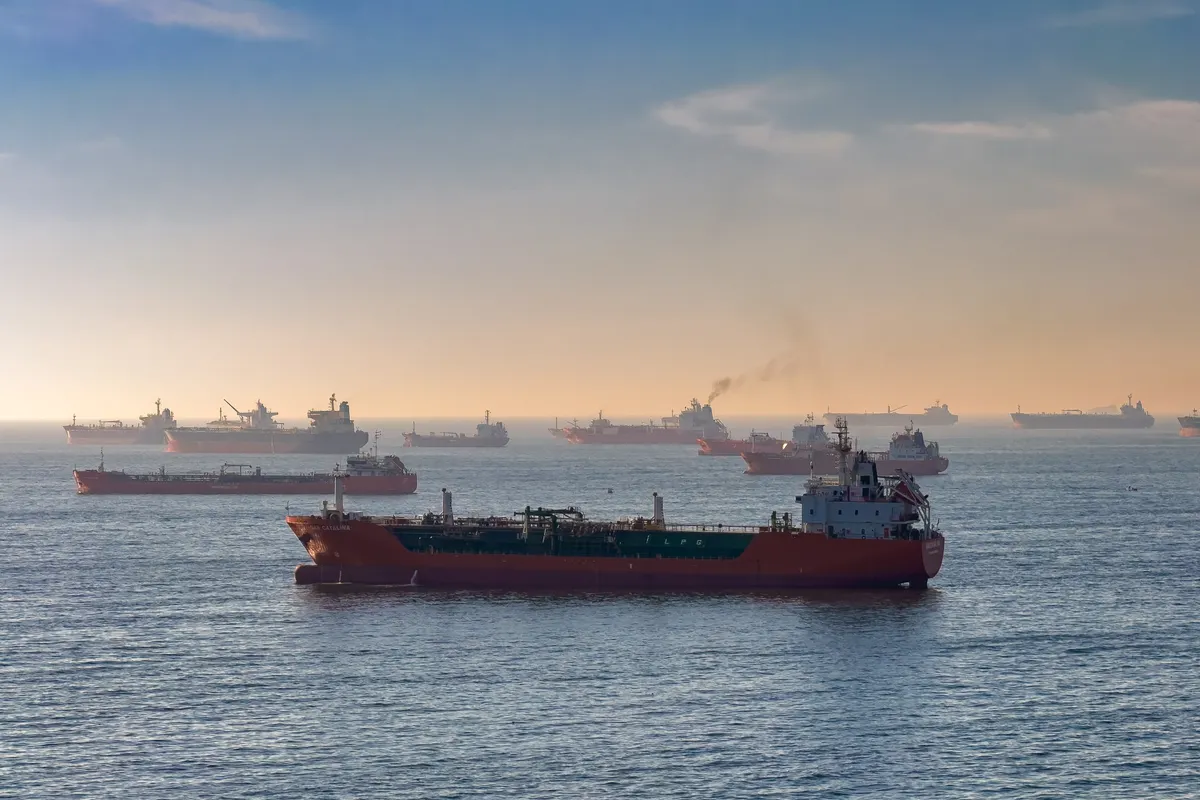
Those figures now look like a different era. Ship-tracking firm Kpler reported that just two vessels passed through the strait on Friday, with no crude oil shipments visible. Data published by France 24 showed that only 388 commodity carriers passed through the strait between 1 March and 15 April, of which 255 were oil and gas tankers. That compares with the hundreds of vessels that had previously transited the passage daily.
The impact on Iranian exports has been severe. According to Baird Maritime, Iran’s crude exports in May were cut to their lowest level in six years, falling to 260,000 barrels per day. That is less than a fifth of the 1.67 million barrels per day average recorded earlier in 2025. The collapse in throughput reflects both the physical reality of the US blockade and the growing reluctance of shipowners to risk their vessels in contested waters.
Kpler had also flagged, ahead of the conflict escalating to its current point, that insurance premiums for vessels in the region had reached six-year highs, making the economics of any transit increasingly difficult even for those willing to attempt it.
Market and commercial consequences
The closure has reshaped energy trading patterns across Asia and Europe, with buyers scrambling to source supply from alternative routes and producers. Oil’s hold around $88 a barrel reflects the ongoing tension between tight supply through the strait and uncertainty about how long the standoff will last.
Trump’s statement that a formal territorial declaration would come ‘pretty soon’ gives no fixed timetable, but it signals that the administration is considering moving beyond the existing blockade posture toward something with a more permanent legal framing. How other major maritime powers and oil-importing nations would respond to such a claim remains an open question that markets are now being forced to weigh.
Iran’s Gharibabadi, for his part, was unequivocal: the strait, he said, ‘will be opened and closed only under Iran’s command.’
